Wednesday, May 8, 2019

Italy - The Final Day (Day 8): Rome...

I remember smacking the snooze button on the alarm clock, and also hitting the snooze button on my phone's alarm, too. I didn't really want to wake up as early as I did (I don't think I ever do), but this was to be my final day in Italy and I didn't want to waste it.

Over the course of the previous week, I'd taken over 3,500 photographs and, to be honest, I was pretty sure I was over it. I just didn't feel like shooting anything this last day and, instead, opted to use it as a day to head into Rome and buy a few souvenirs. Beside, if anything did pop up that I needed to shoot, the camera on the iPhone Xr is pretty formidable.

After a shower and some breakfast I walked over to the train station, which would carry me to the underground station which would get me to the Colosseum. From there I could go anywhere.

I decided I would walk and, man, did I walk; a total of 5.2 miles for the day. 

Of course, everyone's been asking me about the food. Without question, it's some of the best food I've ever had. Everything is ridiculously fresh, and I don't know that they ever use frozen anything. But, as good as the food can be, it can be not so good, too. I don't know about you, but I don't know that I'd be willing to take a chance on a vending machine salmon sandwich in a subway station:


That's some good eatin' right there, ya' think?

But that doesn't mean that there isn't good food to be found in the subway. Fresh sandwiches and paninis are readily available and, like just about everything else you're going to eat in Italy, they're all very fresh.

Depending on the day, they will empty those trays six to ten times a day...

I got to know this platform quite well...


This is pretty much the first thing you see when you leave the underground station...

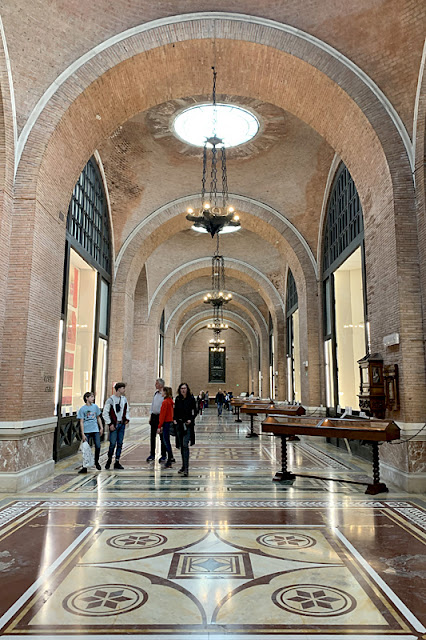
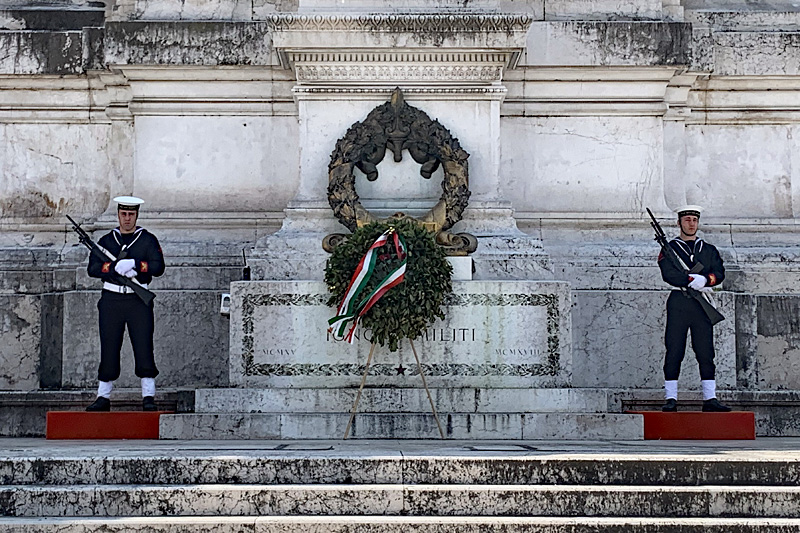
My first stop was the Altare della Patria, which is the monument to Victor Emmanuel II. I'd visited here before, but didn't venture inside. Before doing so, I stopped to photograph the Tomb of the Unknown. Like the American tomb at Arlington, it's guarded 24 hours a day, seven days a week, 365 days a year.

The Tomb of the Unknown...


I have to be honest, I wasn't completely blown away by the inside. Don't get me wrong; it was an amazing piece of architecture and it houses an amazing collection of artifacts. Unfortunately, though, I simply couldn't put anything into context. Everything was written in Italian and, while there some wonderful displays, I had no way of really knowing what they were displays of.


If you want, for €10 you can take an elevator to the roof of the Altare della Patria to get some really nice panoramic views of the city. The line can get a little bit long, and they only take six people at a time, but the vistas are pretty amazing.


Three dominant domes in Rome. The one in the center, by far the largest, is St. Peter's Basilica at the Vatican...


Some views from atop the Altare della Patria...

I don't know what the Hell any of this means, but it got me to the top...


This guy was waiting to get on the elevator. Italian popped collars; a national tragedy...

From the Altare della Patria, I decided to make my way over to the ruins of the Forum. The Forum was once the center of Roman life. Some of the structures here date back to 700 BC, although most are much later in origin. It has served as a venue for processions and elections, criminal trials and public speeches. It's been called the most celebrated meeting place in the world, in all of recorded history.

Pretty heady stuff.


Some of the ruins at the Forum

As I walked along, through the Forum and elsewhere, I found myself marveling at the utterly stunning amount of history there is to be found here. In St. Augustine, we boast about being the oldest city in the United States, and I suppose that's appropriate. But this... man, this is just next level stuff. I mean, come on. They've got a stature of Julius Freakin' Caesar:

Julius Caesar: Dictator Perpetuo (Dictator in Perpetuity)...

I tried to keep in mind that the main purpose of my trip into downtown Rome was to pick up some souvenirs and get a nice dinner, but that plan was repeatedly foiled. As I attempted to make good on my plan, I was again derailed, this time by the Musei Capitolini or, at least, by the Piazza del Campidoglio, which is the plaza atop Campidoglio (Capitoline Hill - English).

The centerpiece of the piazza is a looming statue of none other than Marcus Aurelius, perhaps best known as the compassionate Emperor of Rome in the movie "Gladiator". The statue in the piazza is actually a replica of the original which is housed inside the museum.

Marcus Aurelius...


The Palazzo dei Conservatori, one of the three buildings of the museum...

Looking up at the Palazzo Senatorio in the piazza...

Like so many other things found in Rome, Piazza del Campidoglio was designed by none other than Michaelangelo. The original plans date from 1536, but it wasn't completed until the 17th century, long after Michaelangelo's death.

From there it was down the steps and into the heart of Rome.

Rome is, by a pretty wide margin, one of the the most crowded places I've ever been. Not only is it a city with a population of over 2,500,000, but when you add the ridiculous number of tourists it can get pretty ridiculous. While walking is, for me, the best way to traverse through the city (did I tell you about my Merrell's?), you have to be careful. One of the by-products of so many people is that traffic is just nuts, and many drive as though your ass has a point value. Just watch where you're going and you'll be fine.

All over Rome there are churches. Some, like St. Peter's Basilica, is grand on a scale unknown anywhere else in the world. But all of them, with no exception that I could find, is not ridiculously ornate. There's a lot of variation in the exteriors, but the grandeur of the insides is always impressive.


The facade of the Chiesa di San Marcello al Corso...

The interior of the Chiesa di San Marcello al Corso...

Even though they can appear quite small on the outside, Rome's churches and basilicas are all expansive and profoundly ornate. As a photographer who loves photographing churches, Rome is the most target-rich environment I've ever seen.


The Basilica di Santa Maria Sopra Minerva...


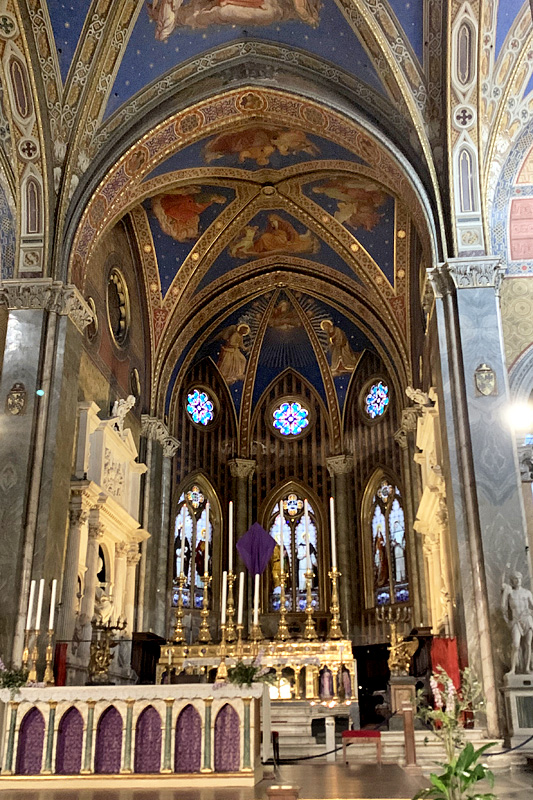
Inside the Basilica di Santa Maria Sopra Minerva...


All of the walking I did certainly came at a price, and it dawned on me that it had been some time since I'd had anything to eat or drink. I decided to address the "drink" part first. I happened upon the Trinity College Bar; an Irish bar smack in the middle of the Italian capital:

Trinity College Pub...


I stepped inside, sat at the bar and was quickly greeted by the bartender. When I mentioned that I wanted something "local", he recommended, and subsequently poured, a pint of Angelo Poretti Lager, which was very good.

A cold, frosty adult beverage...

While sitting there, I struck up a conversation with a young lady named Rosa. 

Meet Rosa...

When I commented that her English was damn-near perfect for an Italian, she replied that she wasn't Italian, but Iranian, but she had come to Italy for her education. We talked as she worked, and the conversation only added to the comfortable environs I found myself in.


After treating myself to two pints (okay, okay... three pints; don't judge) the clock on the wall reminding me I hadn't eaten in some time. It was getting a bit late in the day, so I started to think about dinner. I bid farewell to Rosa and stepped back out into the waning sunlight. I wasn't sure where I would have dinner, but I surmised that, with absolutely zero experience dining in Italy, one place would be as good as the next.
 

But as soon as I stepped into the Taverna del Seminaro, I knew I had freakin' nailed it.


The Taverna del Seminario...
I was greeted by the hostess as soon as I walked through the door. I took a seat at a table near the back and perused the menu. Unknowingly, I settled on what would be the best meal I had during my entire trip: Ricotta and spinach ravioli in a sage butter sauce. 

Oh.

My.

God.

It was sublime. I paired it with a nice glass of some robust red wine and settled into my own little Italian culinary Nirvana. In all honesty, it was so good I almost ordered a second plate. But the thing about the food here is that, though portions are very small by an American's standards, they're quite filling. Never once did I step away from a meal with an unsatiated appetite. 

And I've probably mentioned a time or two how fresh the food is. Taverna del Seminario makes their pasta from scratch, every single day. Oh, and the bread? Yeah, it was freshly baked, too, and some of the best I've ever had.


Ricotta and spinach ravioli, with wine and freshly baked bread. As good as it gets...

I had some rather fine food during my stay, but this was a high point. I just sat there, trying to imagine what it would be like to be able to eat like this every day. In that regard, Italians are pretty damn fortunate.


But, as I finished my glass of wine, and as much as I hated to do it, I had to accept that this adventure-filled vacation was coming to an end. I paid my bill (which was less than €25) and walked out into the waning Italian daylight, back to the Colosseum and, ultimately, back to my hotel...


Despite traveling with thousands of dollars worth of professional photographic equipment, all photographs in this entry were taken with the Apple iPhone Xr...


Sunday, May 5, 2019

Italy - Day 7: Anguilar Sabazia

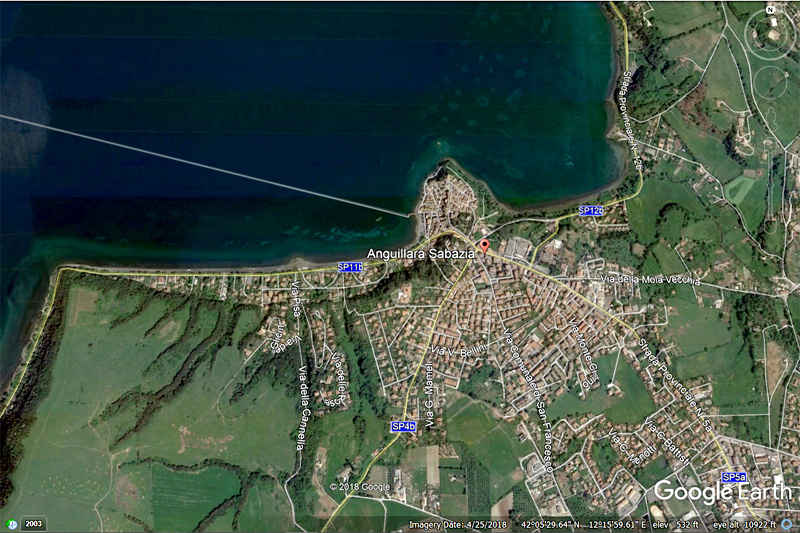
I wanted to get some more use out of the car, so I decided to take a drive out to a little (and I do mean little) town on Lake Brachianno called Anguillara Sabazia (hereafter referred to as "Sabazia"). It's popular with Italian tourists, but most foreigners don't really know about it. The only reason I knew it was there was because I found it on Google Earth.

The Google Earth version of Anguillara Sabazia...

The drive there, though, is about as "into the country" as one can get when venturing out behind the wheel from Rome. At times, it reminded me of drives I've made through Oregon or West Virginia. Being less than 20 miles from Rome, the drive through the countryside was devoid of any highways, which made for a much more enjoyable trip.

This stretched on for miles...

I decided on Sabazia simply because the weather was nice and there was a lake. It's difficult to take a bad photo when those two components are present, so the day was already starting out in  my favor.

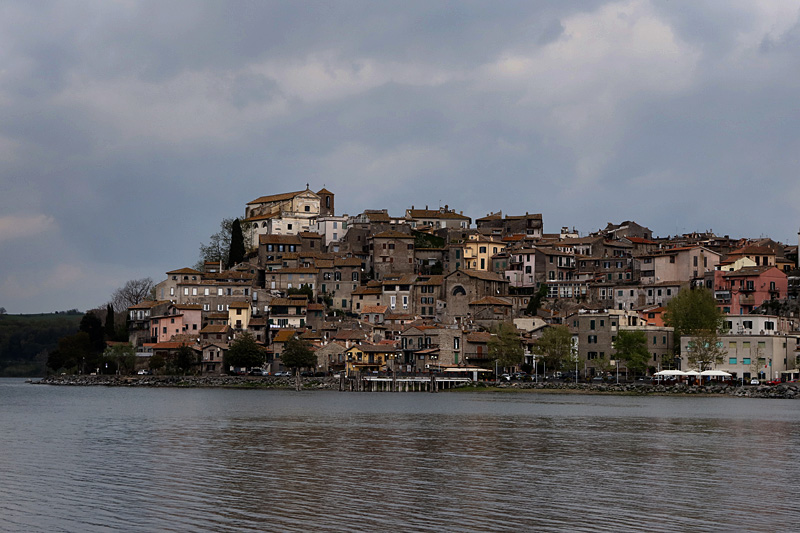
Upon arriving, the first thing I noticed was the town itself; a medieval mass of dwellings basically built on the side of a mountain. This is actually a pretty common site in Italy as smaller, densely populated enclaves were easier to defend.and more difficult to conquer, especially when it's on a lake.


Anguillara Sabazia...

Anguilara Sabazia...

Driving in a place like Sabazia is absolutely nothing like driving in Florence or Rome. There's just nowhere near the traffic and, in fact, quite often the streets are empty.

This doesn't happen in Rome...


A pedestrian walkway along the black sand beach...

I drove around for a time and, next thing I knew, I was driving through the very core of town. I won't go into the gory details here, but suffice it to say that the core of Sabazia is not where an American would hope to find himself driving.

And, yet, there I was.

The streets were barely wider than the car and, in some places, the steps from the doors of the houses resulted in roads which weren't wider than the car. This is a place where Americans have no business driving. I don't care how good you are, or how good you think you are, you aren't. Let's just leave it at that, shall we?

After extricating myself and the Peugeot 308 (which was a great little car, by the way) from the pathway streets of Sabazia, I drove around the lake for a bit until I came across another vista of the town, perched on its lakeside hill.

Anguillara Sabazia from across Lake Brachianno...

If there's one thing I learned about Italy, it's this: If you're not in a big city, a meal can be hard to come by at certain times of day. I was getting hungry. I looked at the dashboard clock and it said 1:40pm. I figured that would be a perfect time for lunch. Unfortunately, the owners of this pleasant looking place didn't agree. You see, after what I assume they believe to be a reasonable lunch hour, a lot of restaurants close until 7:30 or 8:00pm. This was one of those places. Too bad, too, because the menu looked great.

"No soup for you!"

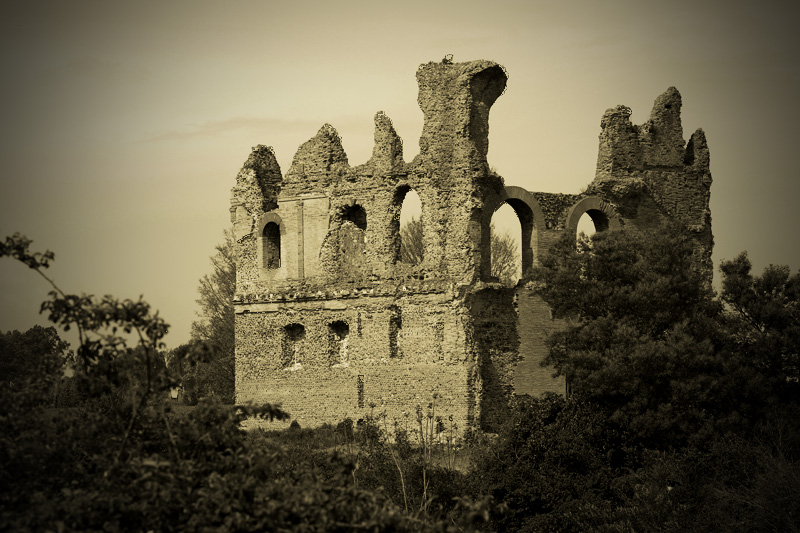
My time in Anguillara Sabazia had come to an end and, as much as I hated to admit it, I was wanting to stay a while longer. There weren't too many shops open, an no restaurants, so it was time to head back to Rome and the comfy confines of my hotel. As I drove out of town, and back towards the city, I was taken by just how much there really is to see when you get into the countryside. This place, which I'd seen driving into Sabazia, just emerged from around a curve. Obviously abandoned, there's no telling what it was or how old it is, and there certainly wasn't anyone around to tell me.

It's one of those things you find in your travels which, despite knowing nothing about it, you know the trip would've been incomplete without it.

Some random ruins south of Anguillara Sabazia...

With only one more day in Italy, I wanted to make sure I got an early start and, well, that meant getting to bed early, as well. I finished the day with dinner, a glass of wine, and the second worst martini I've ever had. 

Tomorrow would be here soon...


Thursday, May 2, 2019

Italy - Day 6: Rome

I decided I wanted to do a bit more exploring in Rome, so I took the underground to the Colosseum and bought a "hop on/hop off" ticket.

There were a number of sites I wanted to see, the first being the Castel San't Angelo:

Castel San't Angelo...


Completed in 139AD, the Castel San't Angelo was commissioned by Emperor Hadrian as a mausoleum for him and his family. As time went on, however, it was used by Popes as both a castle and a fortress. In fact, there's a once-secret passageway that leads from the Vatican to the Castel San't Angelo. Once the tallest building in all of Rome, it's now a museum.

The bridge leading to the Castel is adorned with ten statues of angels, but there's so much more to see than just statues of angels:


Mounted police at the Castel San't Angelo. A police presence is everywhere in Rome...

The stature entitled Angel with the Garment and Dice by Paolo Naldini at the Castel...


Along with the preceding photo, street performers at the Castel San't Angelo...

The Castel San't Angelo...

The sun seen from behind the stature "Angel with Superscription"...

As much as I would've liked to have gotten to go around the city, I fell victim to a guy selling "beat the line" tours at the Vatican. I knew I would be visiting the Vatican while in Rome, so I didn't see much reason not to go now.


St. Peter's Square in The Vatican...

The Vatican is the smallest city-state in the world. Its total area is only about 109 acres and the population, currently, is less than 900 people. Since 1377, the palace has been been the home of 55 Popes, and it's the third largest palace in the world. It has 1,400 rooms, 200 of which serve as apartments for the Pope, the Secretary of State and the highest church officials. Want to live there? Super! You just need to be a Cardinal, a Vatican diplomat, or work in a position which requires that you live within the walls of the Vatican.

The Vatican Museums are among the world's most famous, and it's easy to see why. If you can see past the incredible crowds which traverse through the museums every day, the collection of artwork which awaits you is mind boggling.


Of course, out of all of the artwork people flock to the Vatican to see, the most popular is Michaelangelo's masterpiece: the ceiling of the Sistine Chapel. The ceiling is covered in frescoes by and is over 8,200 square feet is size. It took Michaelangelo over four years to complete it. 

Over 20,000 visitors cram into the Sistine Chapel every day.

Michaelangelo's masterpiece, the ceiling of the Sistine Chapel...


Michaelangelo's masterpiece, the ceiling of the Sistine Chapel...

Michaelangelo's masterpiece, the ceiling of the Sistine Chapel...

Now, I feel the need to be very clear about something: Photography is forbidden inside the Sistine Chapel. 

"Well, Steve", I hear you ask, "How did you get photos if photography is forbidden?"

Fair question.
I was disappointed when I first heard about the ban on photography, but when I discovered why it was banned I became a bit angry. See, I generally take a rather dim view of a "no photography" rule which is driven solely by a financial motive, and that's exactly what has occurred here. When Vatican officials decided it was time to restore Michaelangelo's art inside the chapel, the price tag was more than they bargained for, so they decided to seek outside help. Well, the Nippon Television Network Corporation of Japan offered up $4.2 million in exchange for exclusive photography and video rights inside the Chapel. 

Had the policy been in place because it's a profound place of reverence and devotion, I could've gotten on board with that and I'd have turned my camera off. But to not let someone take non-flash photos (and, to be fair, flash can damage ancient artwork) simply because you want to sell them your postcards in the gift shop?

Yeah, not so much.

I'm the kind of person who normally follows rules to a fault, but I wasn't about to let myself be screwed out of a once in a lifetime opportunity because some Japanese company said I should be screwed out of that once in a lifetime opportunity.

So, after traipsing though the museums and breaking the rules ('cause I'm a rebel and stuff), it was time to head onto what every visitor to the Vatican yearns to experience: St. Peter's Basilica.

Inside the unimaginably huge St. Peter's Basilica...

St. Peter's Basilica (or, formally, the Papal Basilica of St. Peter in the Vatican) is the centerpiece of the Vatican, and is the largest church building in the world. The original building was built in the 4th century over the tomb of St. Peter (which I saw but was not permitted to photograph). The massive dome was designed by Michaelangelo (and did anyone ever call him "Mike" or "Mikey"?). Construction of the current Basilica was started in April of 1506, but wasn't completed until November of 1626.

Michaelangelo took over the task of overseeing the construction in 1547, and he wasn't all too happy about it. He is now, however, regarded as the principal designer of the majority of the building. Said Michaelangelo at the time: "I undertake this only for the love of God and in honour of the Apostle." The Apostle he was referring to was Peter.


St. Peter's Basilica...

Sitting directly below the dome, inside the chapel and directly above the tomb of St. Peter, is Bernini's Baldacchino (canopy), said to be the largest piece of bronze in the world. The high altar of the basilica sits beneath the canopy. Commissioned by Pope Urban VIII in 1623, it was completed in 1634.


The Baldacchino by Gian Lorenzo Bernini...
 

The tomb of St. Peter (photo sourced from Wikipedia)...

Jesus Christ and St. Peter...

St.Longinus, by Gian Lorenzo Bernini...

Most of the sculptures in St. Peter's Basilica are accessible to the public, save one. Michaelangelo's Pieta is now displayed behind a panel of acrylic, bullet proof glass. This was done after Lazlo Toth, a deranged Hungarian geologist, set upon the statue with a hammer on May 21, 1972 screaming "I am Jesus Christ; I have risen from the dead!". He damaged the left arm, Mary's nose and one of her eyelids. It has since been restored.

Interestingly, it's the only piece that Michaelangelo ever signed.

Michaelangelo's Pieta (photo sourced from the web)...

From the main floor of the Basilica I found my way into the Vatican Grottoes. This is where Popes, Kings and Queens are interred. There were only a few I'd hoped to see. Unfortunately, John Paul II wasn't made accessible the day I was there, but others were, including Pope Paul VI. His tomb, however, differs from others in the Grottoes because he asked to be buried in "the true ground". Consequently, his remain were not placed in a sarcophagus as other Popes were. Rather, his body was buried in the ground beneath the marker.

The final resting place of Pope Paul VI

The tomb of Pope John Paul I. He was the first Pope born in the 20th century and served as Pontiff for only 33 days...

To truly explore the entirety of the Vatican, I think, would take weeks. It's just so unbelievably huge that a single day, or even several days, would not be sufficient. Add to that the fact that there are enormous crowds to deal with and, well, you'll understand why it would take a protracted amount of time. And, with regards to the crowds, skip the "guided tours" of the Vatican which are offered all over Rome. Frankly, I was a bit put off by how inefficient the Vatican's procedures were for groups. It's like a cattle drive with art. It may take a little longer to do it on your own, but I think it would end up being a bit more enjoyable.

After I finished exploring St. Peter's Basilica, I made my way back over the the Castel San't Angelo to catch the "hop on/hop off" bus. I made it to the last bus and got off at their final stop, where I found the Santa Maria degli Angeli e dei Martiri, a titular basilica church. Like pretty much every other church in Rome, it's rather plain on the outside.

The rather austere exterior of the Santa Maria degli Angeli e dei Martiri...

Inside the Basilica is a completely different story, though. It's true that most churches in Rome are very plain on the outside, but it's also true that they're quite ornate on the inside. The Santa Maria degli Angeli e dei Martiri is no different:


A replica of the Shroud Of Turin is displayed at the altar inside the Santa Maria degli Angeli e dei Martiri...


After spending an hour or so exploring, I decided it was dinner time. So, I walked back towards the underground station and grabbed some really good pizza (as if there was such a thing as bad pizza?) at one of the bajillion pizza joints in Rome.


No secret what they're selling here...

As I sat there eating, it started to dawn on me that my trip was winding down. There were only two days left before I'd be flying back to the States. In one way I felt like I'd seen such a tremendous amount and, in another, I felt like I hadn't even begun to scratch the surface of what there was to see here.

Maybe that means a second trip is in order...


The Final Hours...

The final hours in Seattle were fun, low voltage and relaxing. Jess and I have learned not to plan minute by minute and having everything la...