Friday, June 7, 2013

Crazy Horse Memorial - Crazy Horse, South Dakota...

As I was planning out my trip, I was excited to learn that the Crazy Horse Memorial was very close to Mount Rushmore (to which I'd assigned "MUST SEE" status). I'd seen bits and pieces on this from time on Discovery and the Travel Channel, and I was psyched that I was going to get to see it first hand. It's a work in progress and, when it's done, will be the largest sculpture in the world.
 
I left Devils Tower and made my way east into South Dakota:
 
 
My first time ever in South Dakota...
 
 
I was getting a bit hungry, so I decided to pull over in Sturgis, South Dakota for some lunch. I opted for The Knuckle Saloon:
 
I've never watched the show, but I'd guess they had a fun time shooting here...

The door (well, one of them) into the Knuckle Saloon...

It's true: They all do...

Some of the decor of the Knuckle Saloon...

Whassat?? Me? With a cup of coffee?? Believe it...
 
 
I'd ordered a burger with Swiss cheese and bacon, and it was pretty damn good for eight bucks. I didn't want to stay too long in Sturgis, as I still had things on the agenda. I enjoyed lunch, paid the check, and then made a quick pit stop:
 
I sure hope my brother wears a "large"...
 
 
My plan was, initially, to spend the night in Rapid City, South Dakota. It's not far from Mount Rushmore, so I figured it would be a good place to set in for the night. I had no reservations, and that was fine. I decided I'd find a place to stay after visiting Crazy Horse and Mount Rushmore.
 
The Crazy Horse Memorial was a bit further from Rapid City than Mount Rushmore, so I decided to hit that first, and work my way back. It was a wonderful drive through some great countryside but, unfortunately, road construction took a little bit of fun out of the drive. When I saw the sign for Crazy Horse, though, I was pumped. This was going to be cool. This was going to be epic.
 
This was going to be the mother of all disappointments.
 
Now, I really try to stay positive when I write this blog, but I'm finding that to be quite a challenge when talking about Crazy Horse. Permit me to explain.
 
The cost for parking and entry into the Visitor Center was $10.00. That, to me, was perfectly acceptable. Parking was easy and, despite the crowds, I found a spot close to the Visitor's Center. Once inside, I was invited to watch a short film about the memorial, and about Korczak Ziolkowski, the designer and original sculptor. Ziolkowski was petitioned by Standing Bear, a Lakota Chief, to do the project after seeing Ziolkowski's work at Mount Rushmore, some 17 miles away. Ziolkowski agreed, and the project began.

What the project has never seen is a single dime of federal funding. Revenue raised through admission fees and gift shop sales help pay for the project, as well as private donations. This is laudable, I suppose, as Ziolkowski always feared that federal involvement would actually result in the project being shelved. His descendants, who now run the project, agree.
 
I spotted an information booth, and wanted to ask about going onto the memorial itself. I knew it was done, for two reasons: First, I've seen photos taken from what will, one day, be the arm of Crazy Horse when the memorial is finished. The second reason I knew it was allowed is because I could see people up there.
 
When I inquired as to the cost to go up, I was stunned, shocked and, yeah, maybe a little disgusted by the reply:
 
$135.00.
 
Say what??
 
The guy then had the audacity to follow that up with "Yes, but $125.00 of that is tax deductible."
 
I quickly reminded him that $135.00 of that was "wallet deductible", and far too spendy for my blood. I thought about it: If a family of four wanted to enter the memorial grounds and ascend to the arm, it would cost $540.00.
 
That's just ridiculous. I get that they don't want to accept federal funding. I think it's a stupid reason not to, simply because I think there would be too big a spotlight on the whole affair to not finish it, but I dig that they want to do it all privately.
 
But $135.00? I literally could've taken a helicopter tour for less.
 
So, as I came to grips with the fact that I wouldn't be going to the arm of the memorial, I decided I would walk to the base of the memorial for a different aspect for my photos. I started walking down this dirt road when I was stopped by an older woman who was obviously a memorial volunteer.
 
She informed me that walking to the base of the memorial was not allowed. If I wanted to go, I'd have to ride in one of their vans, and that would be four dollars, thankyouverymuch.
 
I was dumbfounded.
 
Seriously?
 
It wasn't the fact that it was four dollars for a quarter of a mile trip. What irked me was that I didn't have a choice in the matter. I could see the base of the mountain from where I was standing. I could get there on my own. But, if I wanted to go, I'd have to reach for my wallet. No option.
 
Well, there was one option. I turned my very comfortable Merrell hiking shoes towards the door, and left.
 
Ordinarily, I would post a bunch of photos, but I got spare few here, simply because I didn't feel like taking a bunch of photos of the exact same thing from the exact same angle. That said, here are a few:
 
The Crazy Horse Memorial... Some 65 years after it was started...

A scale model of the memorial in the foreground...

As I said, I was pretty put off by the astronomical price to go to the top of the memorial. As I thought about it, I remembered some of the reservations I'd driven through on this trip. Crazy Horse was Lakota, yet you'd be pretty hard-pressed to find too many Lakota who have the means to pay for a family visit to the top of the memorial. It seems wildly ironic to me. Furthermore, Native American critics believe that Crazy Horse would be appalled at his likeness being carved into a mountain in the hills that he and his people held sacred.
 
With regards to the admission, my belief is that they could lower it to $50.00 (which I probably would've paid), and they'd get more than three times the amount of people going up, thereby making more money for the project (which probably won't be completed in my daughter's lifetime). 
 
But it is what it is and, for that reason, it's really very difficult for me to recommend a visit here. 
 
Considering that I came here with such high expectations, that's a shame...


Wednesday, June 5, 2013

Devils Tower...

I woke up early at the Arrowhead Motel in Buffalo, Wyoming. I'd decided on the Arrowhead after an impromptu internet search for a Mom & Pop place as opposed to a national chain. It was cheesy and cliche, but it was so freakin' cool I'd happily stay there again. After a long day of driving the night before, I just wanted a shower and a comfortable bed, and the Arrowhead had both of those.
 
The Arrowhead Motel in Buffalo, Wyoming...
 
I'd set a pretty optimistic schedule for a single day, and it was going to begin with Devils Tower in Crook County, Wyoming.
 
Now, maybe you don't know what Devils Tower is. But, if you've ever seen the movie "Close Encounters Of The Third Kind", you've seen it. Richard Dreyfuss made a likeness of Devils Tower out of mashed potatoes, and then out of clay:
 
Richard Dreyfuss destroys his living room in 1977. Teri Garr was pissed...
 
When I first saw that movie, I don't know that I was even aware that it was, in fact, a real place. Well, it's not only real, but Devils Tower was the first named United States National Monument. It was given that honor by President Theodore Roosevelt in 1906.
 
And, before someone feels the need to call me on it, you'll notice the absence of an apostrophe in the word "Devils". This is due to a geographic naming standard which eliminates the apostrophe. So, if you have a problem with that, don't blame me. Blame your government.
 
So, Devils Tower...
 
Long before the white man came along, members of the Arapoho, Crow, Cheyenne, Lakota, Kiowa and Shoshone tribes had ties to it, and each had their own name for it. In fact, the name "Devil's Tower" (yes, there used to be an apostrophe) came about due to the misinterpretation of an Indian name to mean "Bad God's Tower", which morphed into "Devils Tower".
 
Devils Tower, which is actually the neck of a long extinct volcano, rests in the upper northeast corner of Wyoming. As I was travelling east on Interstate 90, I jumped off the freeway in the small town of Moorcroft (pop. 1,009), and headed north on Route 14. The first thing you see is a sign letting you know that you've still got a ways to go:
 
 
I found myself expecting to see this monolith around every curve and, before I knew it, I did. It almost seems out of place. The terrain isn't that crazy. Sure, there are hills and such, but there's simply nothing like Devils Tower until, well, you get to Devils Tower. It's difficult to find the appropriate words to describe your first thoughts upon seeing it. From a distance, it almost looks like it could be a mirage; like it could be gone when you come around the next curve. But up closer, there's no denying that it's there, that it's real and that it's amazing.
 
It is, most assuredly, very real:
 
Devils Tower. For those of you keeping score, this photo was taken not with the Canon 5D, but with the Canon G12...
 
The tower itself is made up of igneous material, although there's disagreement on how the tower actually formed. Some say it was formed by an igneous intrusion. Other geologists, later on, searched for further explanations. Some thought the molten rock making the tower might not have surfaced, while other researchers are convinced the tower is all that remains of what once was a large volcano. In 1907, yet another theory was that Devils Tower must be an eroded remnant of a laccolith. This actually proved to be a very popular theory in the earliest 20th century.
 
Whatever its origin, there's no denying that Devils Tower is amazing and it is awesome.
 
As you roll up to the entrance, you're met with one of (I think) the most beautiful park entrances anywhere in the United States:
 
The entrance to Devils Tower National Monument...
 
Once at the Visitor Center parking lot, you're met with two trails you can take to hike around the Tower. I opted for the "Tower Trail". At 1.3 miles long, it's the shortest of the two. The "Red Beds Trail", which was the other, comes in at around three miles:
 
The available hiking trails around Devils Tower...
 
This became one of those times when I was glad I've quit smoking. The hike wasn't strenuous, but there were portions of it which, had I still been hittin' a pack and a half a day, would've required some rest periods. There were plenty of inclines, and I just don't know how my smoker's lungs would've taken to those.
 
Many Native American tribes hold the Tower sacred, and they don't like the fact that it's open to climbers. A compromise was reached, though, in that every June people are requested not to climb. It's only a request, though, but most agree to it. The reason for this is that constellations in the sky line up with certain features on the ground, and this becomes particularly important to the Native American tribes during the Summer Solstice.
 
I had no designs on climbing, so a good mile-plus hike would be all I was in for. Well, that and taking a ton of photos.
 
Before I got too far down the trail, I was reminded that this isn't just a place of recreation for 400,000 people a year, but also a place of deep reverence for others:
 
This sign refers to items left behind by Native American worshippers, who worship here every June...
 
At first, I was a bit bummed because my very first shots of the Tower were going to be taken with me shooting into the sun, which rarely isn't a recipe for disaster:
 
Devils Tower: 8:30am...
 
My mood changed significantly, though, as I made my way down the 1.3 mile trail around the base of the Tower. Photographers love to get that "morning light", and I found that I had it in spades:
 
A well lit Devils Tower...
Devils Tower in the morning light...
 
It's difficult to describe my reaction to Devils Tower. It's an epic thing, to be sure. To me, though, it makes me think of how we, as "man", can get pretty full of ourselves when we do something impressive. But look at Devils Tower. Look at it. Do that. We've done a fair job in our history of doing things to nature, both good and bad, but look at what "nature" is capable of on its own.
 
It makes us almost unnecessary.
 
My hike around the Tower was a good one, and I couldn't help but taking one more shot while I was there. For whatever reason, I wanted a picture of my hand resting on the base of this monolithic masterpiece:
 
The base of the Tower...
 
I felt small.
 
I did a fair amount of shooting, and decided it would probably be best for me to head back to the truck and get back on the road. I needed to get into South Dakota, and on to other things to see, shoot and write about.
 
Devils Tower, though, was impactful, although it's difficult for me, even days later, to put my finger on why that is. It's one of those things which, try as you might, you can't accurately describe or assign a reason to.
 
And maybe it's a waste of time to even try...

Sunday, June 2, 2013

Little Bighorn...

After getting back on the road, I couldn't help but keep thinking about the fact that I was four days behind on some schedule that I'd put together in my head and in Microsoft Word. I had my entire cross-country itinerary laid out, and now it was shot to Hell.
 
But, as much as I felt a bit of angst about getting "behind" so quickly, I was also quick to find the silver lining. Had I left Florence on Wednesday, I would've been slammed with rain through Sioux Falls, South Dakota. But, because I left four days later, the rain's had time to move out, leaving only sunshine for me to shoot with.
 
I wasn't really planning on doing much shooting today. Instead, I planned just to get to my swanky digs at the Arrowhead Motel in Buffalo, Wyoming and be done with the day. Just as I'd decided that I was really looking forward to that, I saw the sign: "Little Bighorn Battlefield National Monument - Next Exit".
 
I had to go.
 
Little Bighorn...
I don't know what I expected Little Bighorn to be, but I suppose I'd always pictured it a little different than what it actually is. I'd always pictured General Custer and his 700 soldiers and scouts as being surrounded by Lakota, Arapaho and Cheyenne Indians, who were at high points around the battlefield. In fact, the opposite is true. What's commonly known as "Custer's Last Stand" took place on what's known as "Last Stand Hill", where Custer and his men had the high point. They were simply overwhelmed by the warriors led by Crazy Horse on June 25-26, 1876.
 
It's an expansive tract of land; some 765 acres. And, strewn throughout the land are marble markers indicating where a soldier fell:
 
These are merely markers, as opposed to gravestones...

No names are present on the majority of the markers of US Army soldiers...
 
Markers also indicate where Indian warriors fell:
 
The marker for a Lakota warrior...
 
The remains of US Army solders, including Custer, were initially buried on the battlefield. Custer's partial remains were re-interred at West Point Military Academy in New York. A mass grave was dug, and unidentified remains of US Army soldiers were buried in that grave. A US Army memorial was erected only feet from where Custer's remains were originally recovered, and near the mass grave:
 
This obelisk contains the names of all US Army soldiers who fell at Little Bighorn...
 
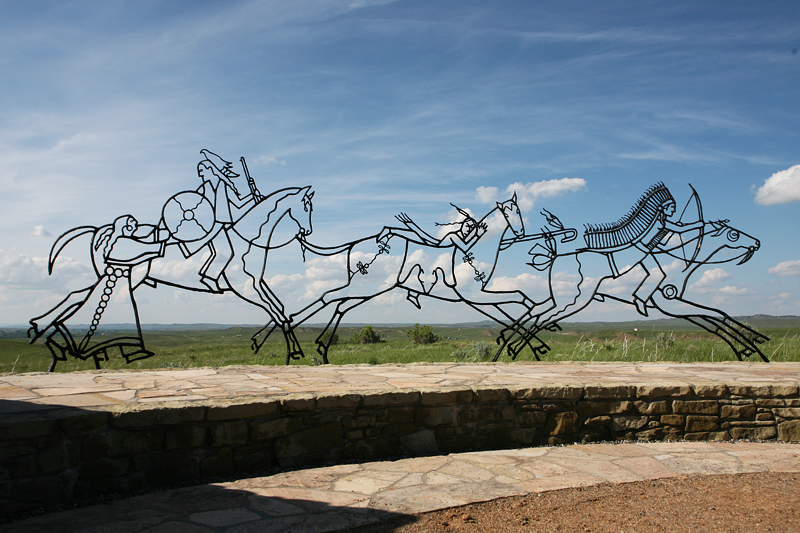
Of course, the Army didn't suffer the only casualties. Lakota, Cheyenne and Arapaho tribes also lost warriors. The fallen Indian warriors have their own memorial on the battlefield. In 1996, the National Park Service - guided by the Little Bighorn Battlefield National Monument Advisory Committee, made up of members from the Indian nations involved in the battle, historians, artists and landscape architects - conducted a national design competition. In 1997 a winning design was selected.
 
The memorial for fallen Indian warriors at Little Bighorn...

The sculpture inside the memorial...
 
Little Bighorn is also the home to Custer National Cemetery. It's been full since the mid 1970's so, if you're a veteran, you can put internment here out of your mind. I have to admit, though, it would be a pretty cool place to call your final resting place.
 

Custer National Cemetery...
 
I'd not set out to visit Little Bighorn, nor did I expect I ever would. But I'm glad I decided to add a couple of hours to my trip. Otherwise, my expectations would've, sadly, been met...

Saturday, June 1, 2013

Hurry Up And Wait!

Of course, the one dark cloud on this trip has been my transmission. Honest to God, I've never heard a sound like that emanate from a motor vehicle before. It was horrid. So, budgeted for or not, it had to get taken care of. Chris knew of a mechanic in town, a block from the Bum Steer, who he highly recommended.
 
I got the truck down there on Wednesday. They got a rebuilt transmission ordered, and it arrived on Friday. When it came in, Brent (the owner) and Wayne got to work. I was confident they would get me back on the road.
 
 
This is my old transmission. I won't identify the last shop that worked on it, but they jerry-rigged some stuff which, thankfully, never failed. But even I could tell that it was piss poor workmanship...

The new transmission...

Brent Sharp, the owner of Sharp Automotive, works on my truck...

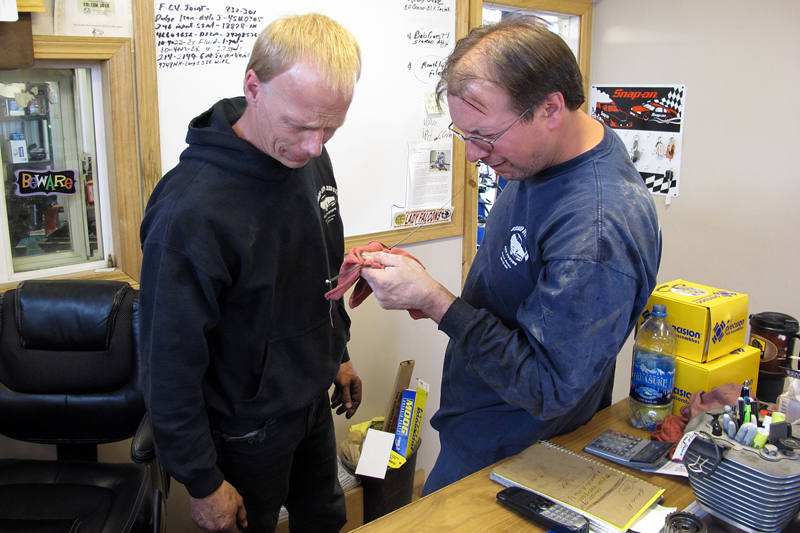
Wayne and Brent examine the new transmission fluid...
 
Brent and Wayne of Sharp Automotive. Highly, highly recommended...
 
Wayne originally told me that they would have the truck done before they closed Friday, May 31. When I stopped by the shop before heading out to do laundry, they told me that they were staying until it was done, regardless of how late it was. They had it done by 6:00pm, but their willingness to do absolutely everything they'd need to in order for me to get back on the road, well, I can't begin to express my appreciation for that.
 
So, I'll bring this short entry to a close by saying that I hope you never, ever find yourself broken down in Florence, Montana. But, if you do, go see these guys. They're totally pro, and really know how to take care of a customer.
 
So, to Brent and Wayne, THANKS!

Friday, May 31, 2013

Montana - Day 3...

Because of the issues with my truck, I wasn't going to be going anywhere for a few days. My buddy Chris Rausch was kind enough to throw me the keys to his truck while he was at work every day, so I could be mobile. On Wednesday, I spent most of my time blogging about Tuesday and driving into Missoula, but Thursday was a photo day for me. Now, anyone who visits here even occasionally knows that I'll sometimes include a photo of my truck. Well, since she's having open heart surgery, I thought I'd include a picture of Chris' truck:
 
Chris' Ford F-350 Super Duty.
Because it's Montana, that's why..
 
I'd decided to stay local, more or less. Chris told me about some cool areas to shoot on the other side of the Bitterroot River, so I packed up the gear into the truck and made my way to the east a bit. 
 
Montana's a bit different than other places I've shot, but I suppose that's something I'll experience daily on this trip. There are enough rivers, lakes, creeks and old barns to keep a photographer busy for weeks. If I had to break down anywhere, I'm glad it was here:
 
Montana is called "Big Sky Country" for a reason...
 
My first stop was right along the Bitterroot River. Rivers are always good. I stopped at a "fishing access" area to get right up on the water:
 
The Bitterroot River...
 
A small pond near the Bitterroot River in Florence..
 
I shot for a bit, then climbed back into the truck and continued down the Eastside Highway, which runs parallel to the Bitterroot. This is where the photo ops began to present themselves, and took advantage of them:
 
What's not to like about an old barn?


A barn, with the Bitterroot Mountains in the background. Lewis & Clark
described the Bitterroots as the most difficult part of their journey...

An old stable which has clearly seen better days...

A horse giving me the stink-eye...

A stream located within the Lee Metcalf National Wildlife Refuge...

In the town of Stevensville, I found an antique shop which had honest-to-goodness antiques. There was some really cool stuff at the Creamery Antique Mall:


This little Indian motorcycle was sitting outside for only 2,200.00...
 
This Harley-Davidson Sprint was $5,000.00...

Not sure what this is, but it sure is old...
This was a cool little kitchen set, not too unlike the one we had when I was growing up in Hauppauge, New York.
But this one was $1,200.00...

These skateboards weren't antiques, but they were pretty cool.
The one on the right was 6' long and was priced at $600.00...

A spare $1,100.00 and this unrestored baby would've been all mine...
 
Well, this IS Montana...

A cool old license plate collection...
 
Right out in the middle of nowhere...

I'm pretty sure this used to be a restaurant. And a train...

After spending the better part of the afternoon shooting, I figured it'd be a good idea to get some food in me, so I made my way back over tho the Bum Steer, where Chris has a fresh batch of pulled pork just waiting for someone to pay attention to it. It was ridiculously good: 


Fresh pulled pork...

My buddy Chris Rausch on the right, with his son Matt...

The Bum Steer in Florence, Montana...
 
And for those wondering, this is where I've spent the last four and a half days. There are worse places to be:
 
The Rausch Estate. An honest to goodness log cabin...
 
The day ended well. All I could do was wait for the shop to get the transmission for my truck, and get me on the road.
 
And that day will be Saturday...


The Final Hours...

The final hours in Seattle were fun, low voltage and relaxing. Jess and I have learned not to plan minute by minute and having everything la...