Sunday, October 20, 2013

Pennsylvania - Day 2...

Pennsylvania is a lot like Oregon, in that it has a wealth of photo opportunities. Now, I consider the Pacific Northwest to be just about the most photographically perfect place I've ever been, so it raised the bar raised pretty high. That said, Pennsylvania's no slouch.

My second day on Pennsylvania would be spent in the small, historic town of Jim Thorpe (also known as the "Switzerland of America"). Now, yes, I know what you're thinking: "Who the Hell gives a nice, quaint little town a name like that?"

Well, the story is a bit unusual.

Jim Thorpe was, and is, widely regarded as one of the greatest athletes ever. He played college football, professional football, professional baseball, and competed in the Stockholm Olympics in 1912. He was an athlete's athlete. The Associated Press named him the third greatest athlete of the 20th century, behind Babe Ruth and Michael Jordan.

Jim Thorpe was born near the small town of Prague, Oklahoma. After he passed away on March 18, 1953, his widow, Patricia, tried to get Oklahoma to erect a memorial to her husband. Oklahoma refused. The small towns of Mauch Chunk and East Mauch Chunk, Pennsylvania, determined to increase business and tourism, actually purchased Jim Thorpe's remains. They combined the two towns into one entity and changed their name to "Jim Thorpe".

Essentially, the town which now bears his name is a town Jim Thorpe had never been to.

An overhead view of the town of Jim Thorpe, Pennsylvania...

Jim Thorpe's tomb, and one of the two statues erected in his honor...

A close-up view of the statue near Thorpe's grave...

The final resting place of Jacobus Franciscus Thorpe. The inscription on the tomb is a quote from King Gustav of Sweden, following Thorpe's 1912 Olympic performance: "Sir, you are the greatest athlete in the world."

Jim Thorpe, the town, is a textbook example of small town Americana. In 2009, it was awarded a top 10 spot on "America’s Coolest Small Towns". In 2012, Jim Thorpe was voted the fourth most beautiful small town in America in the Rand McNally/USA Today Road Rally series.

Originally, Mauch Chunk was a "company town" for the Lehigh Coal & Navigation Co. As is the case with most such towns, it continued to grow and, before long, became an actual town.

Tourism has been a great bright spot for the area, as has outdoor sports such as cycling and white-water rafting. You can enjoy both of those here. The Lehigh River runs right through town.

From a photographer's perspective, Jim Thorpe is wonderful. From trains to mansions to street side houses, it's a visual feast:
 

Engine #426 of the Lehigh Valley Scenic Railway. Tickets for adults, for a one hour, 16-mile scenic journey along the Lehigh River, start at just $12.00 for adults and $9.00 for kids...

The Hotel Switzerland, home of Molly Maguire's Irish Pub...

DeFeo's Manor Bed & Breakfast, one of several in town...

Old bunting draped below a window on West Broadway...

The Asa Packer mansion. Asa Packer established the firm of A. & R. W. Packer, which built canal-boats for the Lehigh Coal & Navigation Company...

Homes along Center Street...

The Black Bread Cafe on Oak Street...

The Carbon County Courthouse...

The Harry Packer mansion, which is now a bed & breakfast. Harry, Asa's son, received the mansion as a wedding gift from his father. The exterior served as the inspiration for Walt Disney's "Haunted Mansion"...

Before visiting here, I never would've guessed that this little town would offer up such an array of things to shoot. For years, I would hear the name "Jim Thorpe" and think "Great name for an athlete. Really silly name for a town". 

Now when I hear that name, I'll remember when I had the chance I had to shoot a true Americana gem in the heart of eastern Pennsylvania's Lehigh Gorge...


Sunday, October 6, 2013

Pennsylvania - Day 1...

The whole point of my cross-country journey was for me to get, ultimately, to Pennsylvania. So, after leaving my buddy Mark's house in Louisville, I did just that. I made my way from my hotel to my cousin's house in Albrightsville, Pennsylvania. The drive wasn't bad and, thankfully, the weather was nice for the majority of the trip.

My cousin also happens to be a photographer, so she'd already planned a few stops for us to make. I'd never been in this part of Pennsylvania, so I was eager to get out with my camera.

For our first day out, we didn't really ave a "plan", per se. It was more of a "wait and see comes around" sort of approach, and it actually worked pretty well.

I'm a big fan of not having to pay to get a good photo op. Sometimes it's unavoidable, such as at places like Mt. Rushmore but, for the most part, free is better.

"Free" certainly describes the two photo filled days I spent in Pennsylvania.

Our first stop was Bear Creek Falls. We almost missed it, but I happened to be looking out the driver's window as we went by. Had I not, I don't know that we would've seen it. We doubled back and got out of the car.

While these were nowhere near the highest falls I've shot (that distinction goes to Multnomah Falls), these were pretty cool. In fact, in the grand scheme of grand waterfalls, these are pretty small. But these were still very cool, and they were easily accessible, requiring only a short walk from where we parked.

Bear Creek Falls...

Bear Creek Falls at 1/4 of a second...


After Bear Creek Falls, we drove over to what was just one of the coolest things I've ever seen. Boulder Field, in Hickory Run State Park, is a National Natural Landmark. It's roughly 17 acres in size, and it's awesome.

The boulder field was created some 20,000 years ago during the most recent glacial period. It was created as a result of the continual freeze and thaw process in the ridges southwest of the field. As the ridges broke apart into boulders, they accumulated on the clay, sand and ice at the base of the ridges. During summer months, the ice in the mass would melt and carry the boulders and finer sediment down the valley to the location of the boulder field today. The boulder field itself is actually about 12 feet deep.

Boulder Field...

Some of these boulders were extremely large. The one at the forefront of this photo, just to the left of center, was about three feet in length.

Boulders, boulders everywhere...

Okay, so it's not a boulder, but it is an example of the local wildlife...

You know, it's things like Bear Creek Falls and Boulder Field which make life with a camera in your hand so enjoyable. When I was first told of Boulder Field, for instance, my initial reaction was "Great, we're going to see a bunch of rocks". But it's really nothing like that, at all. It's a geological feature which you're just not going to find anywhere.

If you happen to find yourself in eastern Pennsylvania, both Bear Creek Falls and Boulder Field are recommended stops. Be forewarned, though. If there hasn't been much rain and/or, the falls can be virtually barren. Recent photos I've seen show a mere trickle.

Boulder Field is pretty much there all the time, though...

Thursday, August 22, 2013

West Virginia State Penitentiary...


My apologies for getting behind on the blog. Now that I'm getting settled in Florida, I'll be
doing my best to get caught up on it here in the next few weeks.

Now...


***CUE GHOST ADVENTURES OPENING MONTAGE SOUND EFFECTS***

Yeah, I know. But, still, I couldn't let the opportunity pass me by.

This is one place I've been wanting to visit for a long time, since first learning of it back in 2008. West Virginia State Penitentiary was closed in 1995 and, since then, has largely been a tourist attraction, with the occasional paranormal investigation thrown in for good measure. In its day, though, it was known as one of the toughest "you don't wanna' end up anywhere near this place when you get locked up" prisons in the entire country.

The building itself kind of sneaks up on you, which is surprising given its impressive demeanor. I crossed the bridge into West Virginia, and there was no sign that I was even anywhere near the prison.

I was about a half a mile away...

I never really expected it to be right across the street from neighborhood homes and picket fences and an ice cream store:

Right across the street from one of the bad-assiest prisons in the country...

Whether I expected it or not didn't really matter. There it was:

West Virginia State Penitentiary in Moundsville, West Virginia...

Almost immediately I had a sense of dread. I've never been to prison, nor do I ever expect that I'll end up in one. But, still, there was no escaping the odd feeling that I was about to walk into a place that many never walked out of.

The reception area contains a small gift shop, along with "Old Sparky", the actual electric chair which was used in the executions of nine condemned prisoners from 1951 until 1959:

Old Sparky...

The most effective way to convey the enormity, as well as the overall sense of dread, of the prison is to do it visually.

Enjoy...

Our tour guide...

This cell block was known as "The Alamo"...

The rear of the prison...
 
The North Wagon Gate, leading in from "the outside" into the rear yard of the prison.
This was the first structure built at the site...

At one time, this was the dining hall...


The ground floor of one of the cell blocks...

A guard tower...

An entrance into the rear of the prison...

Cell doors...

The entrance into the cafeteria...

Graffiti adorns the walls of many 5'x7' cells here...

Inmate graffiti...

An entrance to one of the cell blocks...

Never a shortage of bars in a prison...

An exit to the rear yard...

This "revolving door" allowed access to prison offices and the Warden's residence...

I suppose it's because they got tired of the old one...

This visiting area was for "non-contact" visits...

Another cell block, another overwhelming, ominous feeling...


More bars...

An exit to the rear yard...


Some inmates were permitted to paint their cells...

The prison kitchen...


The prison had facilities which were designed to truly rehabilitate inmates, but conditions at the prison deteriorated greatly over the years. A total of 36 prisoners, including Danny Lehman, were murdered within these walls. Lehman served as a prisoner negotiator during the 1986 riot here.

So, I'm able to put another notch in my Ghost Adventures belt. I've visited several of the same sites as the GAC, but this is, I think, a highlight. If you happen to find yourself near Moundsville, West Virginia with a few hours to spare, I highly recommend taking the tour here.

It'll remind you why you're so happy you've never gone to prison...
 

Friday, July 5, 2013

Louisville, Kentucky: Part 2 - Louisville Slugger Factory & Museum...

When I was a little kid, I played Little League baseball. In later years, I played organized softball. And, from time to time, I would end up using a Louisville Slugger bat.
 
But "Louisville Slugger", the brand, almost never happened.
 
In 1884, legend has it that the son of J.R. Hillerich, 17 year old Bud, skipped out of work at his father's woodworking shop to watch the local professional baseball team, the Louisville Eclipse. When Pete Browning, the team's star player, broke his bat, Bud invited him back to his father's woodworking shop, where he made a bat to Browning's specifications. The next day, Browning went three for three and broke out of his slump. In no time, pro baseball players were trying to have bats made in the small shop.
 
J.R. Hillerich, though, was completely uninterested in making baseball bats, and turned ball players, and their money, away. After a time, though, he relented, and the rest is history.
 
So it is that Louisville Slugger is synonymous with Major League Baseball. Everyone from Babe Ruth to Derek Jeter has stepped out of the dugout carrying a Louisville Slugger.
 
The factory and museum is relatively easy to find. It's in Louisville's "museum row", and parking is relatively easy to find in a lot behind the building. I was there on a weekday, and I think parking set me back two bucks for two hours.
 
And, really, there's no missing the entrance:

This should tip you off that you've found it...
 
Once inside, the first thing that hits you is the smell of sawdust. It's not overwhelming at all, as the factory is still through two sets of doors. Still, you smell it. You know it's there. There will be time for that, though. The museum is a must-see before the factory tour.
 
I guess it goes without saying that a brand as iconic as Louisville Slugger would have some significant bats in its museum's inventory:


This is the bat that Joe DiMaggio used to chalk up a hit in his 56th consecutive game...

Babe Ruth's Louisville Slugger. Well, one of them...
 
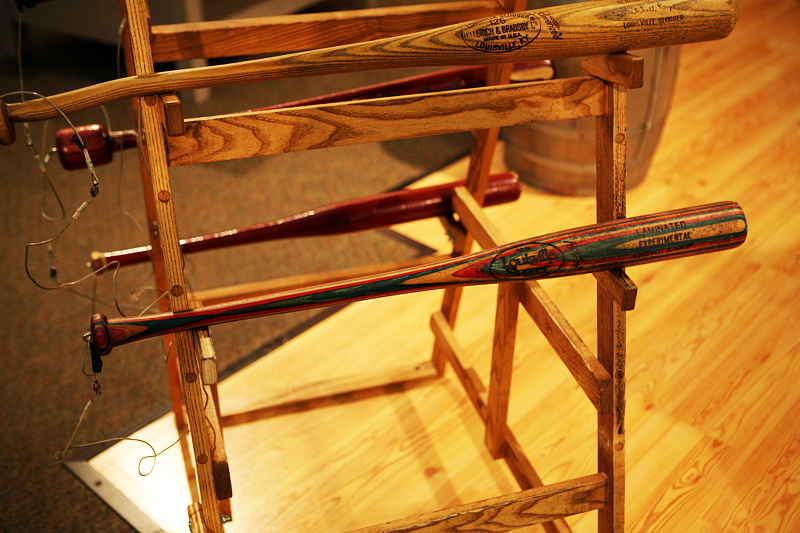
These are some prototype and experimental bats, which may actually never see the light of day...
 
The museum has bats from every era of the company's history, as well as exhibits explaining the science (yes, apparently, science gets involved) of baseball bat production. It proved to be a nice respite from the world driving past outside:
 
Part of the museum's exhibits, with life size statues of Babe Ruth, Ken Griffy Jr., and Derek Jeter...
 
Much to my photographic dismay, photography is forbidden inside the factory. Our tour guide, Miciah (yeah, it's spelled correctly... I think) said that not allowing photography was to protect them from industrial espionage.
 
Pal... C'mon. It's a wooden bat.
 
There was nothing on the tour which even approached anything "revolutionary" with regards to wordworking. Automatic lathes and CNC machines were plentiful, but they weren't doing anything other than shaping bats, which is hardly an industry secret. Be that as it may, photography was verbotten.
 
And, as much as not being able to take pictures sucked, they did make up for it (a little, anyway) by handing out free Louisville Slugger "mini bats" at the end of the tour:
 
 
The gift shop was actually pretty cool. You could order a bat with pretty much anything you wanted printed on it. There was also no shortage of MLB team memorabilia for purchase.
 
I decided it was time to move along, so I found the door, walked past the ginormous baseball bat, and turned the corner to get to my truck. I didn't notice it on the way in, but the planter boxes along the sidewalks by Louisville Slugger are all shaped like home plate:


All in all, it was a nice enough stop. I do wish that photography would've been permitted, but it is what it is. I got to see how an iconic brand is manufactured, and I got some free swag in the process.
 
There are certainly worse ways to spend an afternoon...

The Final Hours...

The final hours in Seattle were fun, low voltage and relaxing. Jess and I have learned not to plan minute by minute and having everything la...